Monday, July 20, 2009


Disposable Wooden Cutlery
Disposable Wooden CutleryEcoware Biodegradables wooden cutlery is a unique and modern alternative to disposable plastic cutlery. Our beautifully crafted birch wood cutlery is a stylish, very affordable, eco-friendly cutlery choice for your next picnic, office or dinner party, special event, wedding, or in your cafe or restaurant! All natural wooden forks, wooden knives, wooden spoons and more are available. Ecoware disposable wooden cutlery comes in retail packs, pre-packaged cutlery sets, bulk cutlery packs, and wholesale. Ecoware Biodegradables disposable wooden cutlery balances quality, price, and environmental concerns to provide a unique and affordable disposable cutlery alternative. Stylish and eco-friendly, disposable cutlery never looked so good! Contact us to inquire or order.
Wooden Cutlery-->-->http://www.ecowareproducts.com/

The Environmental Art of John Dahlson


The Cause of the Economic Downturn


http://images.google.com/imgres?imgurl=http://web.me.com/geerlingguy/articles/philosophy/images/companies-going-green.png&imgrefurl=http://web.me.com/geerlingguy/articles/philosophy/going-green-economy.html&usg=__mDd9Dv3SVvEO0wQEs53CJaaeCLw=&h=224&w=500&sz=9&hl=en&start=11&tbnid=M2w90V7G-bmowM:&tbnh=58&tbnw=130&prev=/images%3Fq%3DThe%2Beconomy%2Bgoing%2Bgreen%26gbv%3D2%26hl%3Den%26sa%3DG

Going Green

data="http://www.thenewsroom.com/mash/swf/cube.swf?a=V3633518&m=723917">


http://www.associatedcontent.com/video/82576/easy_ways_to_go_green.html?cat=57

Cheap Easy Ways to Go Greenhttp://www.5min.com/Video/Cheap-Easy-Ways-to-Go-Green-39341303

How We Live Our Lives - Thoughts About and Benefits of a Green Wedding

Reducing the Footprint of Your Wedding

Justin Segall

Renewable Energy Credits and Carbon Offsets

Reducing the Footprint of Your Wedding

The events surrounding a wedding, just like much of our everyday lives require the use of a significant amount of energy. Whether used by guests travelling by plane and by car, or the electricity used by the wedding, rehearsal dinner, and hotel facilities, energy is used in every aspect of a wedding. The gasoline for cars and planes and the electricity generated and sent through the grid is primarily (over 90%) from greenhouse gas emitting fossil fuels. Transportation and electricity production are MAJOR contributors to global climate change.

Since most of us aren’t able to get to every wedding by walking or riding our bike, and not every facility has solar panels on the roof to produce 100% of the electricity or a wind turbine out in the back, we have to find other ways to make energy consumption as part of a wedding more sustainable.

The primary tools we have to do enable individuals to support renewable energy projects and carbon reduction are known as Renewable Energy Credits (RECs) and Carbon Offsets or Voluntary Emissions Reductions (VERs). Now it just so happens that as Director of Resource Development at Renewable Choice Energy, a leading marketer of RECs and carbon offsets in the US, I lead our efforts to support these types of projects (so that’s why Mandy asked me write this!).

For more information about RECs and carbon offsets, how they work, and what the difference is between them, please visit http://www.renewablechoice.com/residential-why-it-works.html – our marketing people have put together a great series of diagrams and explanations that help make this all much clearer than I could type here.

Carbon offsets have their origin in the Kyoto Protocol signed in 1997 as the international community’s effort to stem anthropogenic (human produced) greenhouse gasses. The voluntary market standards and projects have their basis in the Kyoto Protocol. A carbon offset is measured in units of one metric ton of carbon dioxide equivalent (there are six greenhouse gasses – it’s a lot easier to convert them all to their global warming potential based on the Intergovernmental Panel on Climate Change’s conversions).

The Renewable Energy Credit market is a U.S. based market that has developed into an important element of driving financial and other support for renewable energy development in the United States. One REC equals One Megawatt hour or one thousand kilowatt hours.

Carbon Model

Lets take the example of Mandy’s wedding. For our purposes lets assume:

  • That there are 300 people coming
  • All 300 people are driving an average of 170 miles (distance from Atlanta to Macon).
  • Of those 300 people, 100 of them are flying an average of 2,430 miles roundtrip (that’s my flight from Denver to Atlanta).

The impacts of that travel would be approximately:

  • 51,000 miles driven emitting approximately 50,000 pounds of carbon dioxide
  • 243,000 air miles flown emitting approximately 94,800 pounds of carbon dioxide

That’s a total of 144,800 pounds of carbon dioxide or 65.7 metric tons of CO2. That’s a lot of CO2 emissions for a single weekend!

On the electricity side, you have the electricity used in the hotels people stay in, at the facilities for the dinners and other events. There are a lot of different factors that go into how much electricity those buildings use like how old the building is, how efficient their HVAC and other systems are, whether they have compact fluorescent light bulbs or incandescent, how much they have the air conditioning turned up, etc.

A 100,000 square foot hotel in Macon, GA would:

  • Consume approximately 1,770,000 killowatt hours per year, causing approximately 1,094 metric tons of carbon dioxide emissions.
  • A three day weekend at the hotel (assuming all events occurred there), would use approximately:
    • 14,548 killowat hours and emit approximately 9 metric tons of carbon dioxide.
  • Purchasing 14,548 killowatt hours of Renewable Energy Credits from a wind, biomass, small hydro or other renewable facility (like the products we sell) would ensure that a commensurate amount of renewable energy went onto the grid to offset the power consumed that weekend.

Energy consumption is not typically something that we think about in our daily lives. We flip the switch and the lights come on, we fill up the tank or get on the plane and it goes. There are significant impacts to our energy consumption in the United States – we emit 25% of the world’s greenhouse gases yet account for only about 5% of the world’s population. Tackling our energy consumption by improving efficiency, reducing consumption, and aggressively developing renewable energy is one of the greatest challenges and opportunities in front of us today. Supporting a more sustainable, low carbon energy infrastructure is a contribution every individual can make, and what better time to start that than with a wedding?!?!

Green Legislation at the Local Level

Township's green building ordinance stopped

The Intelligencer

Lower Makefield's green building initiative is at a red light, but just temporarily.

The supervisors directed township solicitor David Truelove and engineer Jim Majewski to halt their work on a proposed ordinance covering new construction or renovations of at least 2,500 square feet on township properties. The proposal was that such work should meet the silver certification of the U.S. Green Building Council's Leadership in Energy and Environmental Design program.

Silver is the second-lowest of the four LEED certifications, which are certified, silver, gold and platinum.

A majority of the supervisors said at their meeting Wednesday night that they still want to put in writing that commitment to green building on township properties, but will decide at the Aug. 19 meeting whether it should take the form of a resolution or ordinance, which is a more detailed document and harder to repeal.

In the meantime, the supervisors will find out how much work Truelove and Majewski already have done on the ordinance and get feedback from the township planning commission and environmental advisory council, which already has done a lot of work on the green building initiative.

The Economic Impact of Wind Power

Assessing the Economic Development Impacts of Wind Power: Final Report

Summary

  • Provides examples of thorough and consistent analysis and documentation of economic impacts from wind power development. Considers three separate case studies as examples, including Lake Benton I (Lincoln County, MN), Vansycle Ridge (Morrow and Umatilla Counties, OR), and Delaware Mountain (Culberson County, TX).
  • Analyzes the economic impact of each of the wind energy projects on employment, income, taxes, and provision of community services.
  • Findings:
    • The projects contributed to significant increases in employment, personal income, tax income, and landowner net revenues.
    • Tax effects, particularly property taxes, were important.
    • Non-market benefits may be important: wind power is a non-polluting, low impact, and non-extractive form of energy that provides large positive benefits to local economies but has a relatively light impact on communities and their infrastructure (schools, roads, and social services).
    • Wind energy development does not involve the "boom and bust" economic and social conditions associated with other energy development.
    • Considered possible negative impacts of wind energy development, such as bird kills, damages to roads, and impact on land values.

The Scientific Method & the Environment : Sound Ecology Requires a Foundation in the Natural Sciences


Welcome to the NROC™ Environmental Science for AP* course. This curriculum covers all of the material outlined by the College Board as necessary to prepare students to pass the AP* Environmental Science exam. This course is designed to acquaint you with the physical, ecological, social, and political principles of environmental science. The scientific method is used to analyze and understand the inter-relationships between humans and the natural environment. The course shows how ecological realities and the material desires of humans often clash, leading to environmental degradation and pollution. The course covers the following topics: Earth's Systems, Human Population Dynamics, Natural Resources, Environmental Quality, Global Changes, and Environment and Society.

Upon completion of this course you will:

  • know and understand the levels of the ecological hierarchy
  • appreciate the integration of natural processes that govern the natural world
  • appreciate the importance of maintaining a sustaining biosphere for the continued presence of a human population on the earth
  • understand the pragmatic and realistic difficulties of integrating human societal needs without further compromising ecological processes
  • become familiar with the ecological background to global environmental problems
  • Realize the consequences of our individual and joint actions upon the biosphere

http://www.montereyinstitute.org/courses/AP%20Environmental%20Science/nroc%20prototype%20files/coursestartc.html

Rapid Displays Going Green

This is another great video I found about going green. Click the link below to watch. Rapid makes a great stride to recycle and reuse everything just to save our environment.

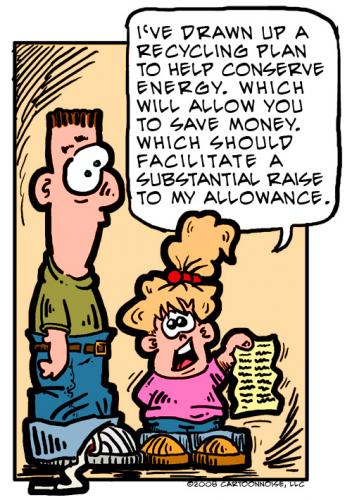
Children Going Green...


Although this is a pretty funny cartoon drawing, it delivers an important message. Even Children are stepping in to show that they will do anything to help save the Planet!


Going Green : Supernews

Click the link below to watch a very well, put together, funny cartoon comedy,that portrays an important message about going green. It is a about a guy who tries to make a step about saving our planet but it's just having a hard time doing the right thing. Click to watch, you will enjoy it.


The GO GREEN Poem


Your trash is torn and gone
But do you know where it goes?
It goes down to the ocean
And ends up in whales blow holes.
You know what to do
It is not a blur
All you have to do
Is recycle your paper.
That is not all
It is not to drastic
Recycling is fun
Recycle papers and plastics!
Now to clean our earth
And get rid of the confusion
We have to clean our water
And stop all the pollution
There is one thing left
It is not in code
It is very easy
Pick up the trash by the rode!
Now our earth is beautiful
And you didn't break your nails
You picked up all the trash
And saved all the whales!
You dont have to be mean
Be nice to the world
And please go green!!

Written by : SpoildBrat101

Technology Can Help Aviation GO GREEN Too!

(This picture shows Richard Branson, the owner

of Virgin Atlantic, throwing a coconut in the air.

Biofuel, made partly from coconut, was used to power a 747 in February.)


The airline industry is seen by many as one of the main culprits when it comes to carbon and greenhouse gas emissions -- and therefore climate change. It has been heavily criticised by environmentalists for perceived inaction over its high CO2 output -- estimated at between two and 10 percent, depending on whose figures you want to trust.
However, with oil prices doubling worldwide in the last year the incentive for the aviation industry to reduce its fuel output is now as much driven by hard economic realities as environmental factors.
Although there have been efforts to mitigate the impact of air travel through initiatives like carbon offsetting, many see this as a short-term solution and as such of limited value.
The search is on to find ways of reducing planes reliance on fossil fuels and according to the CEO of Lufthansa, Wolfgang Mayrhuber there is only one area that will provide the answer in the long run: "technology, technology and again technology."


THE BIOFUEL OPTION


Within the airline industry itself many are putting their faith in biofuel as a viable alternative to petroleum fuels. So-called first generation biofuel is made from organic materials -- often food crops -- that are broken down to produce oil or alcohol fuel like ethanol.
Its chief champion so far is the owner of Virgin Atlantic, the tycoon Richard Branson, who has pledged to invest profits from his transport empire in to biofuel production.
The use of biofuel remains contentious, however, with claims that harvesting of the crops needed to make the fuel robs locals in the developing world of valuable farmland thereby pushing up food prices. Environmentalists also argue that it often leads to deforestation, making any CO2 savings largely redundant.
Mindful of these criticisms, Branson used a mix of coconut oil harvested from existing plantations and oil from palms that grow wild to fuel a flight from London to Amsterdam earlier this year. The Virgin Atlantic 747 that left Heathrow in February was the first commercial aircraft to be powered partly by biofuel.


GOING GREEN WITH ALGAE


Other airlines are looking away from the land for the solution. Boeing has joined energy giants such as Chevron Corp. and Royal Dutch Shell in supporting research in to the use of algae.
Researchers have already managed to extract vegetable oil from algae harvested on ponds. It is still only at its early stages but scientists believe algae could potentially produce much higher yields than other biofuel with the added advantage that it would not take up valuable farmland.
Two members of staff from Boeing sit on the board of directors of the Algal Biomass Organization, a U.S. trade body set up to accelerate research and funding into its use as an aviation fuel.

(This picture shows Scientists researching

using algae as an aviation fuel. It it believed it

could produce higher yields than other biofuels)

To read the full article on how Technology can help Aviation Go Green, please visit:

http://www.cnn.com/2008/BUSINESS/07/15/biofuel.aviation/index.html