Thursday, July 23, 2009

Analysis & Perspective of Going Green

The Going Green movement, spurred by fears of global warming, is an international movement encouraging society to minimize its impact on the environment. It involves a myriad of strategies that range from minimizing citizens carbon footprints, utilization of renewable sources of energy, and green consumerism – individuals making purchasing decisions based on a products relative environmental friendliness.

Sound environmental policy is grounded in the physical sciences. There are legislative, economic, and cultural issues that are impacted as a result of this societal shift. How individual countries embrace the movement, how countries influence one another to enact sound environmental policies, and how businesses and citizens react to how they are impacted is being played out today. Any progress is good, but I expect it will take decades for the world’s citizens to share a common viewpoint on their own and society’s role in managing the world’s resources. The role of self-interest has to be put asisde and sacrifices made on behalf of long-term benefit for the movement to realize complete success.

What Does Going Green Mean to me?


I believe that "Going Green" is something that everyone in this country needs to do in order to ensure we have a healthy Country! After doing this assignment I have realized how important it really is to Go Green and I will try to do whatever I can to help the country Go Green. There are so many different things people can do to help the economy Go Green. IT could be something as simple as buying recycled grocery bags so that you don’t have to use brown or plastic bags every time you go to the store. Taking a shorter shower, riding your bike or walking to work, buying a water filter instead of bottled water, recycle your electronics and make your own cleaning products. These are all simple ways that you can help the economy Go Green!
Water, People, and the Environment


Water has influenced the rise and fall of civilizations throughout history. Water resources continually teach societies about the interconnections to be found in the environment, and of the need for an ecology-based perspective. History reveals that people have always had a special affinity towards water. Water quantity and quality concerns are basic to society's well-being, and water-related issues continue to be vitally important to environmental movements in the United States and worldwide.
Firemen spray water on the tug Arizona as a fire sweeps the docks in Cleveland, Ohio in November 1952. The fire, which started in an oil slick on the Cuyahoga River, destroyed three tugs, three buildings, and the ship repair yards. A similar fire in June 1969 received nationwide attention and brought a sharp focus on environmental quality issues.
http://www.pollutionissues.com/Ve-Z/Water-Pollution-Freshwater.html

China, World Leader in Renewable Energy

Powering China's Development
The Role of Renewable EnergyBeijing-based researcher Eric Martinot, a Worldwatch senior fellow, and Li Junfeng, Vice Chair of China’s Renewable Energy Society in Beijing, examine China’s progress in becoming a global leader in renewable energy. With the breakneck expansion of China’s economy and its reliance on coal, the country grapples with the far-reaching environmental, security, and social implications of its growth. A combination of ambitious targets supported by strong government policies and the manufacturing prowess of the Chinese may enable China to “leapfrog” so-called industrialized nations in renewable technology in the years immediately ahead.China will likely achieve—and may even exceed—its target to obtain 15 percent of its energy from renewables by 2020. If China’s commitment to diversifying its energy supply and becoming a global leader in renewables manufacturing persists, renewable energy could provide over 30 percent of the nation’s energy by 2050.
With its booming economy and rapidly expanding energy consumption,particularly its use of coal and oil,it is imperative for China to diversify its energy supplies. China’s carbon dioxide emissions are on the rise and are expected to exceed total U.S. carbon dioxide emissions shortly, although Chinese per-capita emissions remain about one-sixth those of the United States.
More than $50 billion was invested in renewable energy worldwide in 2006, and China is expected to invest over $10 billion in new renewables capacity in 2007, second only to Germany. Wind and solar energy are expanding particularly rapidly in China, with production of wind turbines and solar cells both doubling in 2006. China is poised to pass world solar and wind manufacturing leaders in Europe, Japan, and North America in the next three years, and it already dominates the markets for solar hot water and small hydropower.

Powering China's Development: The Role of Renewable Energy

http://www.worldwatch.org/node/5496?gclid=CID0i62E7JsCFQJ2xgodiDou0A

What does "going green" mean to me?

I must admit that when I first saw an assignment titled "Going Green" , I didn't quite know what to expect. Was this another art project? Would I have to paint my face and chest with green paint and attend a Packers versus Giants football game for extra credit? Would I have to sing a duet with Kermit and Miss Piggy? Would I have to eat lots of fruit and leafy, green vegetables and well, you know, literally go green? Happily, no to all of those images. Through the process of researching the earth's limited natural resources and studying the effect legislature, the economy and science have on developing technology, I now understand the real significance of the phrase "going green". Going Green is a personal choice for all Americans . To me, it means ensuring that there will be fresh, green pasture for my horses, clean air and water for my children and grandchildren and newer technologies making my life longer and more enjoyable. Going Green? Sign me up!

The Scientific Method and Going Green

THE PROBLEM: The earth's natural resources (water, coal, oil, trees) are in limited supply. Human life can not exist on earth without resources that supply food, water and energy to mankind.

SPARK'S HYPOTHESIS: Sparks hypothesizes that it is necessary for sustainable resources to be further developed to ensure the continued existence of mankind on earth.

SPARK'S PREDICTIONS for the FUTURE:

1. We predict that mankind will continue to develop sustainable resources like wind power
and solar energy to preserve the earth's natural resources.

2. We predict that a balanced interplay of legislature, economic development and
scientific technology are necessary to further develop sustainable resources.

3. We predict that the world will embrace green technology as an important,
routine part of everyday life.

4. We predict that the Spark's Going Green Blog will make an important contribution to
educating students about the significance of going green.


TEST the HYPOTHESIS: Members of Sparks have researched the problems contributing to the decline of available natural resources , the factors necessary for the further development of sustainable technologies and the significance that going green plays in preserving existing natural resources. Sparks research data is presented below in the format of an educational blog. THE FUTURE IS THE REAL TEST FOR OUR HYPOTHESIS. Please read, enjoy, and learn from Sparks educational blog posted below.


CONCLUSION: Much more work needs to be done to continue to develop sustainable technologies and to educate the world about the significance of the going green movement.

Tuesday, July 21, 2009

Mind-Boggling Green Facts & Statistics - 8


If the entire world lived like the average American, we’d need 5 planets to provide enough resources. Even if you’re the most dedicated treehugger out there, if you’re American, your carbon footprint is still double the per-capita average of most of the world. Though America would have to reduce our carbon-emitting habits by 83% in order to be sustainable, that’s not quite as insurmountable as it sounds. A shift toward renewable energy, conservation, more efficient waste management and greater concentrations of people living in dense urban communities will go far toward decreasing our carbon footprint as a nation.

CREDITS: ALL MIND-BOGGLING FACTS & STATISTICTS TAKEN FROM: http://webecoist.com/2008/11/26/amazing-frightening-green-facts-environmental-statistics/ THESE WERE ONLY SOME OF THE ONES THAT CAPTURED MY ATTENTION BUT THERE IS MORE THAN THIS TO IT.

Mind-Boggling Green Facts & Statistics - 7


The human population on earth has grown more in the last 50 years than it did in the previous 4 million years. It took almost all of human history – until the early 1800s - to reach a global population of 1 billion. Today, we’re at over 6.7 billion and adding an estimated 74 million people to the planet every year. In fact, the United Nations believes that we’ll reach 9 billion by 2050. Such a large population will put a huge strain on already stretched resources, making severe food and water shortages far more likely.

Mind-Boggling Green Facts & Statistics - 6

One in four mammals is at risk of extinction. Marine mammals in particular face even steeper odds, with one in three threatened. Humans are mostly to blame as we’ve encroached upon their habitats, polluted the earth and hunted far too many of them. The problem is especially bad in Asia, where agricultural expansion and development of infrastructure has led to a staggering statistic: 79 percent of the continent’s primate species face extinction. Across the world, 78 percent of marine mammals are threatened by accidental deaths such as getting caught in fishing nets intended for other species.

Mind-Boggling Green Facts & Statistics - 5

Recycling one ton of paper saves 17 trees, 2 barrels of oil, 4,100 kilowatts of energy, 3.2 cubic yards of landfill space and 60 pounds of air pollution. Recycling one aluminum can saves enough electricity to power a TV for three hours, and aluminum cans can be recycled an unlimited number of times. Recycling a ton of glass saves the equivalent to 9 gallons of oil. Increasing steel recycling by 50% would save the energy equivalent to 7 nuclear power plants. These statistics show just how important recycling really is, and how much we need to ramp it up.

Mind-Boggling Green Facts & Statistics - 4

Within 10 years, wind power could provide 20% of America’s power.North Dakota alone could theoretically produce enough wind-generated power to meet the needs of more than a fourth of U.S. electricity demand. And, offshore wind turbines have the potential to produce as much power as all of the power plants in the United States. America definitely needs a new modernized power grid to harness wind energy, but as T. Boone Pickens points out, “If the government commits to modernizing our nation’s power grid in the same fashion that we modernized our highways, we can make some serious progress in a relatively short time.”

Mind-Boggling Green Facts & Statistics - 3

America is the queen of trash. Every day in the U.S., we produce enough trash to equal the weight of the Empire State Building. We throw away 2.5 million plastic bottles every hour, produce enough styrofoam cups annually to circle the earth 436 times and trash enough office paper to build a 12-foot wall form Los Angeles to New York City. We throw away 570 disposable diapers each second, and toss out enough aluminum cans to rebuild our commercial air fleet every three months. Each year we fill enough garbage trucks to stretch from Earth halfway to the moon.

And of course, not all trash even makes it to the landfill. The Great Pacific Garbage Patch, which is a swirling vortex of waste and debris in the Pacific Ocean, covers an area twice the size of the continental U.S. and is believed to hold almost 100 million tons of garbage.

Mind-Boggling Green Facts & Statistics - 2

Less than 1% of the world’s freshwater is readily available for human use. The amount of water that’s safe for us to use is declining sharply due to pollution and contamination. 87% of freshwater resources are used for agriculture, as much of 60% of that is wasted due to inefficient watering systems.

With the population boom and global warming, we’re going to be fighting over water by mid-century. In fact, in Asia – where water has always been considered an abundant resource – per capita availability of freshwater has declined by 40%-60% between 1955 and 1990, and most Asian countries are expected to have severe water shortages by 2025.

Despite these problems, many people – Americans and Australians in particular – are wasting water as if it will always be plentiful. The average American uses far more water than citizens of other countries – about 550 liters per day. The average American household uses 300 gallons of water daily, with many wasting thousands of gallons every year on lawn irrigation.

Mind-Boggling Green Facts & Statistics - 1

Oxygen-starved dead zones that cannot sustain life now cover an area roughly the size of the state of Oregon. Spanish researchers alsorecently found that many species die off at oxygen levels well above what is now considered uninhabitable, suggesting that the extent of dead zones in coastal areas is greater than previously known. Dead zones are caused by excess nitrogen from farm fertilizers, factory and vehicle emissions, sewage and other pollution runoff.

Going Green & Our Economy

Whether it's hybrid, electric, or biofuel, the change to a cleaner & long term future in transportation is coming along. It may have needed a jump start from rising oil & gasoline prices, but the future is here & it looks bright. At first, the few hybrids on the roads only seemed to be taking hold in the "hippie" households. But before long, Toyota was handling backorders on the Prius & they were becoming more & more popular on the roadways. Now it's a difficult task to try and drive to your local supermarket without passing a few of these odd looking vehicles. And this is a good sign, both for our environment & for our economy. You may ask yourself why this is good for toureconomy because yes, Toyota is a foreign auto maker. But this proves that a shift in the auto market is drastically approaching & our American auto makers better get on board. While it took them a while to get the ball rolling, our hometown auto makers are progressively working toward alternative fuel vehicles. This means that while a lull may have currently hit our economy in all sectors, once the ball is up to full speed down the "green" hill, our economy will take off. The American work force is full of smart, intelligent business people who know the future is in cleaner, more fuel efficient vehicles. And I fully expect our economy to show just how bright our citizens & businesses are by being the global leader in all things green. Our economy looks very bleak right now, but hold faith that the world's new found love with the green movement will be the saving grace for our economy. Our cities & states will breath cleaner air while our businesses reap the monetary rewards for their green ideas & innovations.


Going Green: Legislature Looking to Turn Trends into Law


Do you think that the green revolution is just a trend? According to this article at My Suburban Life, many green initiatives that companies have been implementing mostly to save costs might soon become, by law, necessary actions that all companies in a given industry must take. Green initiatives make sense from both an environmental aspect and the long-term cost-savings aspect. If companies want to be leaders in their given industries, they ought to look to implement as many green initiatives as soon as possible. It’s not just simply the right thing to do, it also puts them ahead of the curve when some of these green initiative items become law…and that helps lead to a decisive competitive advantage.


Sustainable Development


Scheme of sustainable development: at the confluence of three constituent parts [1]
(environmental, economic, social development)
Sustainable development
Excerps from Wikipedia, the free encyclopedia ;see http://en.wikipedia.org/wiki/Sustainable_development

Environmental law

Theory
Earth jurisprudence
Sustainable development

Specific issues
Asbestos

Environmental impact assessment


Sustainable development is a pattern of resource use that aims to meet human needs while preserving the environment so that these needs can be met not only in the present, but also for future generations. The term was used by the Brundtland Commission which coined what has become the most often-quoted definition of sustainable development as development that "meets the needs of the present without compromising the ability of future generations to meet their own needs."[2][3]
Sustainable development ties together concern for the carrying capacity of natural systems with the social challenges facing humanity. As early as the 1970s "sustainability" was employed to describe an economy "in equilibrium with basic ecological support systems."[4] Ecologists have pointed to the “limits of growth”[5] and presented the alternative of a “steady state economy”[6] in order to address environmental concerns.
The field of sustainable development can be conceptually broken into three constituent parts: environmental sustainability, economic sustainability and sociopolitical sustainability

1 ^ UCN. 2006. The Future of Sustainability: Re-thinking Environment and Development in
the Twenty-first Century. Report of the IUCN Renowned Thinkers Meeting, 29-31
January, 2006 http://cmsdata.iucn.org/downloads/iucn_future_of_sustanability.pdf
2 ^ United Nations. 1987."Report of the World Commission on Environment and Development." General Assembly Resolution 42/187, 11 December 1987. Retrieved: 2007-04-12
3 ^ Smith, Charles; Rees, Gareth (1998). Economic Development, 2nd edition. Basingstoke: Macmillan. ISBN 0333722280.
4 ^ Stivers, R. 1976. The Sustainable Society: Ethics and Economic Growth. Philadelphia: Westminster Press.
5 ^ Meadows, D., Meadows, D. L., Randers, J., & Behrens, W. 1971. The Limits to Growth. New York: Universe Books.
6 ^ Daly, H. E. 1973. Towards a Steady State Economy. San Francisco: Freeman. Daly, H. E. 1991. Steady-State Economics (2nd ed.). Washington, D.C.: Island Press.

A Seven Point Beginner's Guide to Going Green

A 7-Point Beginner’s Guide to Going Green Written by Sara on August 18th, 2008 - Topics: Food and Health, Geography and Travel, Home and Garden, Tricks and Hacks, Vehicles and Transit
Going green: where to start?
If you are interested in living a more eco-friendly lifestyle, this is for you. We hope you will find WebEcoist to be pleasantly free of politics and we’ll never tell you to eat granola, hug a tree or vote for the Greens. You don’t even have to switch to tofu. The great thing about modern green living is that there is truly room for every lifestyle – from green consumers to chic eco mamas to tech-obsessed geeks. Modern green living is for people interested in living harder, better, faster, stronger (to paraphase Daft Punk). If that sounds like you, you’re in the right place. Do you view life as an ongoing learning experiment?
Then here’s what you need to do to go green:
1. Reduce, Reuse, Recycle
This classic mantra is still the most important one. Next to the crisis of climate change, resources (particularly petroleum, water and food) are getting ever more scarce. We must relearn the “three R’s” – and we’re not talking about grammar school. There are literally thousands of things you can do, large and small, to help the environment. Most of them benefit you in addition to helping the planet. Some are cheap, some are expensive, and many are free. But before you go and purchase carbon offsets or consider a hybrid, first just shift your mindset. Reuse, reduce, recycle – it’s fundamental for anyone who wants to go green.
Getting started: just begin observing your daily habits and purchases. Do you need to throw everything away? Is there something permanent you could use instead of that disposable version? Can you donate, compost, or trade that widget? Once you make the mental shift from a NIMBY (not in my backyard) approach that is wasteful and careless, you’ll be ready for higher-level greening. Ready for more? Read on for the overview. In future posts we’ll bring you detailed breakdowns of everything you need to go green – but this summary will help you know what to expect.
2. Transportation
We’re not only running out of accessible petroleum reserves – the global political climate isn’t exactly friendly to gas prices. If you didn’t worry about the environmental effects before, the cost of filling up the tank has just about everyone looking for ways to save green. Come back soon to find tips for mass transit that doesn’t suck, carpooling that doesn’t kill, and telecommuting that your boss actually goes for. You’ll also learn about the more extreme and wacky tips you might want to try, from hyper-miling to alternative modes of transport. It’ll be good for the planet and your wallet, too.
Getting started: Simply begin exploring your options. If you can purchase a hybrid or more fuel-efficient car, that’s great. Try asking your boss about telecommuting a few days a week, and take advantage of mass transit if you have access in your area.
3. Shopping
Purists may deride “eco products” as nothing more than greenwash or a new marketing opportunity, but consider:
- We are consumers and that’s not going to change soon.
- Some of the latest and best green innovations are coming from consumer-driven trends. Buying organic jeans is not going to save the planet, but green consumption is helping to “mainstream” green living. Besides, green these days is pretty cool. You won’t believe how hard you can geek out on all kinds of green tech, green gadgets, and green hacks. Think longer battery life. Think a water container that won’t give you cancer, soap that doesn’t dry your skin out and a safer toilet-scrubbing experience. And be sure to let us know what kind of consumables you’re interested in greening. Since many products can be made at home, we’ll also be sharing DIY money-saving tips for many necessities.
Getting started: look for fair trade, organic, and eco-friendly labels or certification on goods you buy. Choose local meat, dairy, and produce when you can. Try not to buy “fast fashion” and needless gadgets that are cheap but will soon fall apart. Invest in quality over quantity. Buy your furnishings and electronics used when you can. Read your favorite magazines and books online instead of choosing print versions. Avoid plastic when a sustainable alternative is available such as wood, metal, fiber or bioplastic.
4. Food
Green grub is not just tofu and organic carrots. Really. In future posts, you’ll learn about the foods you don’t have to buy organic and cheap ways to buy the ones you do. You’ll learn about food miles and whether local is really best. You’ll find out how you can be a green steak lover. Green food should be healthy, cheap, delicious and accessible – and it can be, so stay tuned.
Getting started: for now, start shopping at the farmers’ market for your veggies because they’ll be a lot cheaper and healthier and safer. Eat a vegetarian dinner one day a week. Cut back on the soda, fast food and other overly-packaged and processed junk. You don’t have to do it all at once – try going “100% whole food” one day a week to start.
5. Your Pad
The home is the easiest place to start greening. There are literally hundreds of relatively easy home hacks – many free and most inexpensive. (Note that we will be providing in-depth guides to you super DIY’ers out there who want to get extreme. Bookmark this page and check back in the future for updated links to new posts.)
Getting started: you can switch dead light bulbs with CFLs, buy a programmable thermostat, toughen up a little and adjust your heat and A/C by two degrees of comfort, buy a compost bucket, and give up disposables like paper plates and paper towels. You can also use eco-friendly detergent, carpet cleaner, soap, plant fertilizer, pet food…it goes on and on! Many of these things you can make yourself for pennies. Which helps to offset the cost of that LED plasma.
6. Lifestyle
This ties into Reduce, Reuse, Recycle, but goes a little deeper. Is your laundry green? What about your workplace? Are you greening your travel? What gifts can you give at holidays that aren’t going to hurt the environment (without annoying your friends and family)? Look for upcoing lifestyle guides that go beyond generic clichĂ©s and address green solutions for every kind of lifestyle. So you have an SUV and there’s no way you can trade it in for what they’re offering – no problem. You can still be green. Maybe you are addicted to the latest gadgets, or you’re a die-hard designer shoe girl. Maybe you refuse to give up your burgers. That’s O.K. – there is a green way of doing things for every lifestyle. No challenge is impossible to solve with creativity, investigation, and a little bit of humor. If you think that’s too ambitious, you’re probably not in the right place. But if you are excited by new, innovative ideas and solutions with a positive point of view, stick around.
Getting started: Get out a notebook and write down the following: how often you travel; how often you dine out; how many family members/dependents you have; how far you drive to work; where you shop for your food, clothing, household products and electronics. This will give you a pretty good idea of your lifestyle. You should also figure out your carbon footprint. Don’t worry; no changes to make yet. Simply take stock of how you live so you can make smart changes down the road.
7. Habits
This is a bit different from lifestyle; the lifestyles people lead – based on family size, location, profession and so on – are diverse. But habits are more about the daily actions we take, often without thinking. You will find helpful tips, hacks and tricks in the future to live a little greener without too much stress. Sane green living is the goal. Whether it is turning off your lights or saving water, check back weekly for new tips.
Getting started: like “reduce, reuse, recycle”, simply make it a goal to consciously think about your habits this week. Do you order take-out or do you shop at the farmers’ market and prep your veggies for fast meals during the week? Do you shop at stores that use sweat shop labor to produce their goods, or do you look for products that are either fair-trade certified or made in the U.S.A.? Do you buy heavily processed junk food on a regular basis or do you try to avoid it? What cleaning products are you using? Simply start thinking about your habits. There are so many habits where, with slight modification, you can quickly reduce your carbon footprint.
Of course, this is simply an overview of the areas where you “green up”. You might want to bookmark this post and come back for links to more in-depth articles in the future.

http://webecoist.com/2008/08/18/a-beginners-guide-to-going-green/

Global Warming

blog.lib.umn.edu/ellis271/arch1701/bigstockph...

Global Warming / Project Millenium Development
Global Warming is an environmental issue that is continuing to harm our planet. The definition of Global Warming is “the increase in the average temperature of the Earth’s near-surface air and oceans since the mid-twentieth century and its projected continuation��? (wikipedia.org) which means that if in the winter the snow melts faster than it snows then there has to be something wrong with Earth because how else can you explain average temperature for many years that change one year? The answer is Global Warming. It is dangerous and unless we as people investigate more into the causes of Global Warming and how to prevent Global Warming then the world would over heat and eventually burn.
For further examples there are icebergs melting in Antarctica and Alaska for nothing other than Global Warming because those icebergs are what those places are known for and for all of sudden to begin melting gradually year after year is astounding and frightening all at the same time. There are singers, such as Sheryl Crow, that have had songs that dealt with telling audiences about Global Warming, that it is real and beginning to surface. In Melbourne, Fl they “endured 24 days above 95 degrees and Tampa remained above 80 degrees F at nighttime for 12 days��? (climatehotmap.org).
There are steps to prevent Global Warming such as “minimizing drafts in your home, reducing your waste electricity use, using more efficient light bulbs, turning down your water heater, and being the change you wish to see��? (energyefficienthomearticles.com). These are simple steps to help make the world a better place. Doing your research on Global Warming and what other organizations are doing in order to prevent Global Warming is important because we as people caused Global Warming slowly but surely and we need to learn how to prevent it from continuing to happen.

http://blog.lib.umn.edu/cgi-bin/mt-tb.cgi/78817

PLEASE
Watch this interesting TV commercial about Global Warming:

Monday, July 20, 2009


Disposable Wooden Cutlery
Disposable Wooden CutleryEcoware Biodegradables wooden cutlery is a unique and modern alternative to disposable plastic cutlery. Our beautifully crafted birch wood cutlery is a stylish, very affordable, eco-friendly cutlery choice for your next picnic, office or dinner party, special event, wedding, or in your cafe or restaurant! All natural wooden forks, wooden knives, wooden spoons and more are available. Ecoware disposable wooden cutlery comes in retail packs, pre-packaged cutlery sets, bulk cutlery packs, and wholesale. Ecoware Biodegradables disposable wooden cutlery balances quality, price, and environmental concerns to provide a unique and affordable disposable cutlery alternative. Stylish and eco-friendly, disposable cutlery never looked so good! Contact us to inquire or order.
Wooden Cutlery-->-->http://www.ecowareproducts.com/

The Environmental Art of John Dahlson


The Cause of the Economic Downturn


http://images.google.com/imgres?imgurl=http://web.me.com/geerlingguy/articles/philosophy/images/companies-going-green.png&imgrefurl=http://web.me.com/geerlingguy/articles/philosophy/going-green-economy.html&usg=__mDd9Dv3SVvEO0wQEs53CJaaeCLw=&h=224&w=500&sz=9&hl=en&start=11&tbnid=M2w90V7G-bmowM:&tbnh=58&tbnw=130&prev=/images%3Fq%3DThe%2Beconomy%2Bgoing%2Bgreen%26gbv%3D2%26hl%3Den%26sa%3DG

Going Green

data="http://www.thenewsroom.com/mash/swf/cube.swf?a=V3633518&m=723917">


http://www.associatedcontent.com/video/82576/easy_ways_to_go_green.html?cat=57

Cheap Easy Ways to Go Greenhttp://www.5min.com/Video/Cheap-Easy-Ways-to-Go-Green-39341303

How We Live Our Lives - Thoughts About and Benefits of a Green Wedding

Reducing the Footprint of Your Wedding

Justin Segall

Renewable Energy Credits and Carbon Offsets

Reducing the Footprint of Your Wedding

The events surrounding a wedding, just like much of our everyday lives require the use of a significant amount of energy. Whether used by guests travelling by plane and by car, or the electricity used by the wedding, rehearsal dinner, and hotel facilities, energy is used in every aspect of a wedding. The gasoline for cars and planes and the electricity generated and sent through the grid is primarily (over 90%) from greenhouse gas emitting fossil fuels. Transportation and electricity production are MAJOR contributors to global climate change.

Since most of us aren’t able to get to every wedding by walking or riding our bike, and not every facility has solar panels on the roof to produce 100% of the electricity or a wind turbine out in the back, we have to find other ways to make energy consumption as part of a wedding more sustainable.

The primary tools we have to do enable individuals to support renewable energy projects and carbon reduction are known as Renewable Energy Credits (RECs) and Carbon Offsets or Voluntary Emissions Reductions (VERs). Now it just so happens that as Director of Resource Development at Renewable Choice Energy, a leading marketer of RECs and carbon offsets in the US, I lead our efforts to support these types of projects (so that’s why Mandy asked me write this!).

For more information about RECs and carbon offsets, how they work, and what the difference is between them, please visit http://www.renewablechoice.com/residential-why-it-works.html – our marketing people have put together a great series of diagrams and explanations that help make this all much clearer than I could type here.

Carbon offsets have their origin in the Kyoto Protocol signed in 1997 as the international community’s effort to stem anthropogenic (human produced) greenhouse gasses. The voluntary market standards and projects have their basis in the Kyoto Protocol. A carbon offset is measured in units of one metric ton of carbon dioxide equivalent (there are six greenhouse gasses – it’s a lot easier to convert them all to their global warming potential based on the Intergovernmental Panel on Climate Change’s conversions).

The Renewable Energy Credit market is a U.S. based market that has developed into an important element of driving financial and other support for renewable energy development in the United States. One REC equals One Megawatt hour or one thousand kilowatt hours.

Carbon Model

Lets take the example of Mandy’s wedding. For our purposes lets assume:

  • That there are 300 people coming
  • All 300 people are driving an average of 170 miles (distance from Atlanta to Macon).
  • Of those 300 people, 100 of them are flying an average of 2,430 miles roundtrip (that’s my flight from Denver to Atlanta).

The impacts of that travel would be approximately:

  • 51,000 miles driven emitting approximately 50,000 pounds of carbon dioxide
  • 243,000 air miles flown emitting approximately 94,800 pounds of carbon dioxide

That’s a total of 144,800 pounds of carbon dioxide or 65.7 metric tons of CO2. That’s a lot of CO2 emissions for a single weekend!

On the electricity side, you have the electricity used in the hotels people stay in, at the facilities for the dinners and other events. There are a lot of different factors that go into how much electricity those buildings use like how old the building is, how efficient their HVAC and other systems are, whether they have compact fluorescent light bulbs or incandescent, how much they have the air conditioning turned up, etc.

A 100,000 square foot hotel in Macon, GA would:

  • Consume approximately 1,770,000 killowatt hours per year, causing approximately 1,094 metric tons of carbon dioxide emissions.
  • A three day weekend at the hotel (assuming all events occurred there), would use approximately:
    • 14,548 killowat hours and emit approximately 9 metric tons of carbon dioxide.
  • Purchasing 14,548 killowatt hours of Renewable Energy Credits from a wind, biomass, small hydro or other renewable facility (like the products we sell) would ensure that a commensurate amount of renewable energy went onto the grid to offset the power consumed that weekend.

Energy consumption is not typically something that we think about in our daily lives. We flip the switch and the lights come on, we fill up the tank or get on the plane and it goes. There are significant impacts to our energy consumption in the United States – we emit 25% of the world’s greenhouse gases yet account for only about 5% of the world’s population. Tackling our energy consumption by improving efficiency, reducing consumption, and aggressively developing renewable energy is one of the greatest challenges and opportunities in front of us today. Supporting a more sustainable, low carbon energy infrastructure is a contribution every individual can make, and what better time to start that than with a wedding?!?!

Green Legislation at the Local Level

Township's green building ordinance stopped

The Intelligencer

Lower Makefield's green building initiative is at a red light, but just temporarily.

The supervisors directed township solicitor David Truelove and engineer Jim Majewski to halt their work on a proposed ordinance covering new construction or renovations of at least 2,500 square feet on township properties. The proposal was that such work should meet the silver certification of the U.S. Green Building Council's Leadership in Energy and Environmental Design program.

Silver is the second-lowest of the four LEED certifications, which are certified, silver, gold and platinum.

A majority of the supervisors said at their meeting Wednesday night that they still want to put in writing that commitment to green building on township properties, but will decide at the Aug. 19 meeting whether it should take the form of a resolution or ordinance, which is a more detailed document and harder to repeal.

In the meantime, the supervisors will find out how much work Truelove and Majewski already have done on the ordinance and get feedback from the township planning commission and environmental advisory council, which already has done a lot of work on the green building initiative.

The Economic Impact of Wind Power

Assessing the Economic Development Impacts of Wind Power: Final Report

Summary

  • Provides examples of thorough and consistent analysis and documentation of economic impacts from wind power development. Considers three separate case studies as examples, including Lake Benton I (Lincoln County, MN), Vansycle Ridge (Morrow and Umatilla Counties, OR), and Delaware Mountain (Culberson County, TX).
  • Analyzes the economic impact of each of the wind energy projects on employment, income, taxes, and provision of community services.
  • Findings:
    • The projects contributed to significant increases in employment, personal income, tax income, and landowner net revenues.
    • Tax effects, particularly property taxes, were important.
    • Non-market benefits may be important: wind power is a non-polluting, low impact, and non-extractive form of energy that provides large positive benefits to local economies but has a relatively light impact on communities and their infrastructure (schools, roads, and social services).
    • Wind energy development does not involve the "boom and bust" economic and social conditions associated with other energy development.
    • Considered possible negative impacts of wind energy development, such as bird kills, damages to roads, and impact on land values.

The Scientific Method & the Environment : Sound Ecology Requires a Foundation in the Natural Sciences


Welcome to the NROC™ Environmental Science for AP* course. This curriculum covers all of the material outlined by the College Board as necessary to prepare students to pass the AP* Environmental Science exam. This course is designed to acquaint you with the physical, ecological, social, and political principles of environmental science. The scientific method is used to analyze and understand the inter-relationships between humans and the natural environment. The course shows how ecological realities and the material desires of humans often clash, leading to environmental degradation and pollution. The course covers the following topics: Earth's Systems, Human Population Dynamics, Natural Resources, Environmental Quality, Global Changes, and Environment and Society.

Upon completion of this course you will:

  • know and understand the levels of the ecological hierarchy
  • appreciate the integration of natural processes that govern the natural world
  • appreciate the importance of maintaining a sustaining biosphere for the continued presence of a human population on the earth
  • understand the pragmatic and realistic difficulties of integrating human societal needs without further compromising ecological processes
  • become familiar with the ecological background to global environmental problems
  • Realize the consequences of our individual and joint actions upon the biosphere

http://www.montereyinstitute.org/courses/AP%20Environmental%20Science/nroc%20prototype%20files/coursestartc.html

Rapid Displays Going Green

This is another great video I found about going green. Click the link below to watch. Rapid makes a great stride to recycle and reuse everything just to save our environment.

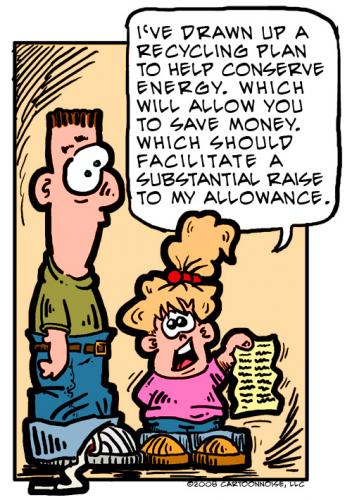
Children Going Green...


Although this is a pretty funny cartoon drawing, it delivers an important message. Even Children are stepping in to show that they will do anything to help save the Planet!


Going Green : Supernews

Click the link below to watch a very well, put together, funny cartoon comedy,that portrays an important message about going green. It is a about a guy who tries to make a step about saving our planet but it's just having a hard time doing the right thing. Click to watch, you will enjoy it.


The GO GREEN Poem


Your trash is torn and gone
But do you know where it goes?
It goes down to the ocean
And ends up in whales blow holes.
You know what to do
It is not a blur
All you have to do
Is recycle your paper.
That is not all
It is not to drastic
Recycling is fun
Recycle papers and plastics!
Now to clean our earth
And get rid of the confusion
We have to clean our water
And stop all the pollution
There is one thing left
It is not in code
It is very easy
Pick up the trash by the rode!
Now our earth is beautiful
And you didn't break your nails
You picked up all the trash
And saved all the whales!
You dont have to be mean
Be nice to the world
And please go green!!

Written by : SpoildBrat101

Technology Can Help Aviation GO GREEN Too!

(This picture shows Richard Branson, the owner

of Virgin Atlantic, throwing a coconut in the air.

Biofuel, made partly from coconut, was used to power a 747 in February.)


The airline industry is seen by many as one of the main culprits when it comes to carbon and greenhouse gas emissions -- and therefore climate change. It has been heavily criticised by environmentalists for perceived inaction over its high CO2 output -- estimated at between two and 10 percent, depending on whose figures you want to trust.
However, with oil prices doubling worldwide in the last year the incentive for the aviation industry to reduce its fuel output is now as much driven by hard economic realities as environmental factors.
Although there have been efforts to mitigate the impact of air travel through initiatives like carbon offsetting, many see this as a short-term solution and as such of limited value.
The search is on to find ways of reducing planes reliance on fossil fuels and according to the CEO of Lufthansa, Wolfgang Mayrhuber there is only one area that will provide the answer in the long run: "technology, technology and again technology."


THE BIOFUEL OPTION


Within the airline industry itself many are putting their faith in biofuel as a viable alternative to petroleum fuels. So-called first generation biofuel is made from organic materials -- often food crops -- that are broken down to produce oil or alcohol fuel like ethanol.
Its chief champion so far is the owner of Virgin Atlantic, the tycoon Richard Branson, who has pledged to invest profits from his transport empire in to biofuel production.
The use of biofuel remains contentious, however, with claims that harvesting of the crops needed to make the fuel robs locals in the developing world of valuable farmland thereby pushing up food prices. Environmentalists also argue that it often leads to deforestation, making any CO2 savings largely redundant.
Mindful of these criticisms, Branson used a mix of coconut oil harvested from existing plantations and oil from palms that grow wild to fuel a flight from London to Amsterdam earlier this year. The Virgin Atlantic 747 that left Heathrow in February was the first commercial aircraft to be powered partly by biofuel.


GOING GREEN WITH ALGAE


Other airlines are looking away from the land for the solution. Boeing has joined energy giants such as Chevron Corp. and Royal Dutch Shell in supporting research in to the use of algae.
Researchers have already managed to extract vegetable oil from algae harvested on ponds. It is still only at its early stages but scientists believe algae could potentially produce much higher yields than other biofuel with the added advantage that it would not take up valuable farmland.
Two members of staff from Boeing sit on the board of directors of the Algal Biomass Organization, a U.S. trade body set up to accelerate research and funding into its use as an aviation fuel.

(This picture shows Scientists researching

using algae as an aviation fuel. It it believed it

could produce higher yields than other biofuels)

To read the full article on how Technology can help Aviation Go Green, please visit:

http://www.cnn.com/2008/BUSINESS/07/15/biofuel.aviation/index.html


Sunday, July 19, 2009

The Ultimate GO GREEN Cleaner... Baking Soda?


It may be hard to beleive that baking soda can be one of our very simple steps, to start "Going Green". HOW? It is very easy. If you are a clean freak, like myself, baking soda is the way to go, keeps things fresh and clean. Baking soda can be used for many things. For example, have you ever had your kitchen drain or bathroom drain clogg, and you were forced to clean it with one of those bleachy smelling drain cleaners. Well, those drain cleaners are made with substances that our environment can not handle, that is why baking soda is safe to use, clean and keeps things smelling fresh. Here is how to clean your drains with baking soda:

Pour 1/2 baking soda down your kitchen or bathroom drain, immediately, follow it by 1/2 cup vinegar, then, immediately pour some hot boiling water down the drain. This will break down the fatty acids that can build up in drains. Easy right? Keep in mind that this is not only safe to our environment, but it will also leave it smelling fresh.

What does "Going Green" Mean?

What does "Going Green" really mean? Does it mean we have to become tree huggers? You might be suprised that Going Green can mean just starting out with one simple step and growing from there. The concept of Going Green is to help our environment, reduce our pollution problems and save our planet. Going Green does not have to be hard, so don't let the "Going Green Snobs" turn you off from dong your part to help our Planet! As we proceed with this blog, you will see that there are many simple steps YOU can take to help our planet.

Going Green is about how to live a more sustainable, environmentally friendly lifestyle, and how to do it without breaking the bank or suggesting such a drastic change in the way you live that it seems impossible to accomplish. The thing about going green is that it should be a win-win; it should make your life easier, more fulfilling, more pleasurable, healthier and more fun, while taking care of the health and well being of our planet and the millions of folks that share it.
This Blog will feature green tips and suggestions, as well as resources for anyone and everyone.

13 Ways to Go Green!

13 Ways to Go Green and Save Money


1. Grow Your Own
“The biggest thing I’m doing this year is growing my own vegetable garden. It will be organic, and it doesn’t get any more local than my own back yard. Plus, it’s one heck of a money saver. It will even help me build community, because I will surely have extra fruits and vegetables to share with my neighbors.”
— Jessica S., Littleton, CO Real Green: Food That Nourishes People and the Planet »

2. One Less Car
“I don’t own a car. Even in the cold Minnesota winters you’ll find me biking. Riding a bicycle obviously saves money and resources, but I believe it also builds community. When I am on a bicycle, I feel more connected to my surroundings, and I’m more approachable. I’m always saying hello to people as I ride past, whereas in a car, that interaction would be lost.”
— Sarah P., Minneapolis, MN Real Green: The Case for Electric Bikes »
3. One Less Car, Part Two
“Although I get 48 miles per gallon with my hybrid car, I still make every effort to plan my trips to avoid needless driving, to carpool, and to take public transportation and telecommute, as often as possible. I write and call my political leaders in support of laws and funding for mass transit, and for greener cars.”
— Jeanne T., Springfield, VA Real Green: Carpool for the Climate and Community(online tools make carpooling easier than ever) »
Green American: Fuels for the Future »

4. Reuse, Reuse, Reuse
“One way I have discovered to keep items out of landfills and save a bunch of money in the process is FreeCycle – an online group where members post things they are looking for, and what they have to get rid of. I have received a dining room set (complete with six chairs, buffet, and hutch), bunk beds for my kids, a set of night stands, and a really good juicer for no cost. And I’ve used FreeCycle to give away all the clothes that my kids have outgrown.”
— Lea P-W., Painesville, OH Real Green: Finding Used Items Online »
Green American: 25 Ways to Green the World(get what you need without money) »

5. Stop the Leaks
“I’m unplugging the toaster, lamps, cell phone chargers, laptops, and other electronic devices when I’m not using them. These things leak energy needlessly when they are plugged in all the time. It’s the quickest way to save energy and it saves me money on the electric bill too.”
— Rachelle N., Nashville, TN Green American: Efficiency First! »
23 Steps Toward Energy Efficiency »

6. Harness the Sun
“We installed solar panels on our townhome in March along with another family in our homeowners’ association. Several others had expressed interest before the economic meltdown and then backed off, but we hope that with our example others will see that in the long-run it’s a money-saver, and they will understand the benefit for both the planet and their bottom lines.”
— Ellen S., Boulder, CONew Tax Credits for Going Solar in 2009 »
Real Green: Making Solar Affordable Now »
Faces of the Green Pages: Evergreen Energy »

7. Waste Not, Want Not
“I compost. I keep my garbage creation to a minimum. I refuse packaging and bags whenever possible (bringing my own cloth bag). I explain to the checkout person why I am refusing the bag or giving back the packaging. Also, steel is 100-percent recyclable. The recycled steel isn’t downgraded or ‘downcycled.' I recycle every unusable nail, every screw, every wire, etc., at my local transfer station. Even my steel roof will be recycled when it is done being my roof.”
— Ruth O., White Salmon, WA Real Green: Pick a Composter, Any Composter »
Green American: Getting to Zero Waste »
21 Things You Didn't Know You Can Recycle »

8. Dispense With Disposables
“This may seem like a minor thing, but it really helps on my limited budget. I have ceased purchasing paper towels and instead use old rags for cleaning and wiping up spills. I wash the dirty rags and reuse them until they wear out. I didn’t realize how many paper towels I used to go through before I started this new system.”
— Sarah F., Tullahoma, TN 10 Things Never to Buy Again »

9. Reallocate Your Resources
“Our path toward sustainability began when we realized the value of doing things for ourselves. I began by making our own laundry detergent. It is all-natural and costs less than a penny per ounce to make! We used the money we were saving to take bigger steps: buying our meat in bulk from local farmers who raise their animals on pasture and sustainably, and buying Energy-Star appliances for our house.”
— Carrie C., Salem, VA Real Green: Ten Simple Ways to Clean Green »
Green American: Heal Your Home Guide »
Real Green: Buying the Best Appliances »

10. Examine Your Diet
“By becoming vegan I cut my carbon footprint to at least 60 percent and the amount of money that each meal costs me by an average of 78 percent. Beans and legumes are so inexpensive compared to meat! I cut costs even more by growing herbs and vegetables for myself, and I earn fruits by offering to do the picking for friends with fruit trees, in exchange for keeping the surplus. I preserve them in glass jars and make pickled fruits and vegetables to extend them even further .”
— Sarah F., Tullahoma, TN Real Green: Eat Less Meat, Cool the Planet »
Real Green: Think Globally, Can Locally »

11. Green celebrations!
“On June 20, I am getting married green style. Oh, green wedding, how do I love thee? Let me count the ways: 1) Used wedding dress from eBay, $10!, 2) Organic, Fair Trade apparel for the wedding party that they can use afterwards, 3) Asking guests to carpool to save gas, money, and the environment, 4) Sending plantable wedding invitations [That’s right, you bury the invitations and wildflowers spring forth, just like love blooms…], 5) Using leftover supplies from my cousin’s wedding, 6) Buying organic flowers from the farmer’s market … and more. My fiancĂ© Mark and I will be celebrating our day free from wedding-induced debt and the weight of a heavy carbon footprint!”
— Michelle B., Oshkosh, WI Faces of the Green Pages: The Green Bride Guide »
Real Green: Green Weddings and More »

12. Invest Wisely (and Needs vs. Wants)
“We’re always asking ourselves whether this next purchase is a ‘need’ or a ‘want.’ When we actually stop to think about it, there are precious few needs. People say things like ‘I need cable TV,’ but that’s probably not true. Calling such things ‘needs’ cheapens the meaning of the word. We’ve also begun investing some savings with a community bank. Interestingly, in our experience, the smaller community bank with the social mission has been reliably beating the pants off of the mega-banks in terms of rate of return. We know that we’re saving more by getting the higher rate of return, but we are also proud that our money is doing good in the community as well!”
— Steve O., Mamaroneck, NY Break Up With Your Bank »
Green American : From Greed to Green (shift society's underlying values) »

13. What Really Matters?
“I’m trying to stay focused on people and relationships rather than stuff. This helps me consider who is affected by what I do buy and from whom I buy it. I save by buying only thrift store clothes, but splurge on Fair Trade chocolate. I support locally owned businesses. I volunteer my time. And with some of the money I save, I use it to support organizations that help people help themselves. I do without stuff; that isn’t what matters anyway!”
— Kelly G., Charlotte, NC Green America's Fair Trade Guide »
Real Green: 7 Fixes from the Green Economy »